
Violent assault does not usually happen the way people imagine it.
Most people picture violence as something with a clear beginning, a dramatic warning, and enough time to decide what to do. Real assault is usually uglier than that. It is sudden, compressed, disorienting, and overwhelming by design.
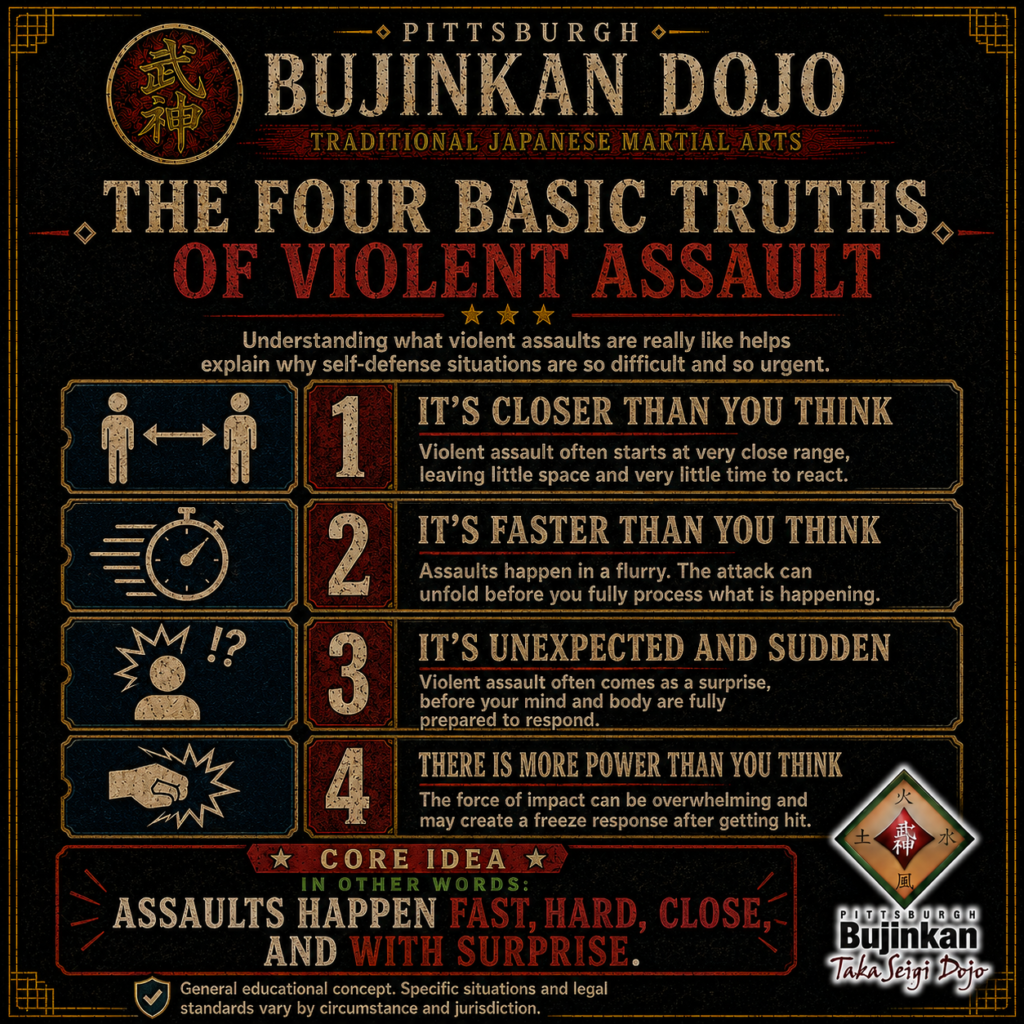
There are four basic truths worth understanding:
It is closer than you think.
It is faster than you think.
It is more sudden than you think.
It carries more power than you think.
That matters because predators do not want a fair fight. They do not want you ready, balanced, prepared, and aware. In predatory violence, the attacker wants advantage. They want access. They want surprise. They want you isolated, distracted, confused, or trapped inside a range where they can act before you can fully process what is happening.
This is why assaults often begin at close range.
The attacker may position themselves within arm’s reach before anything obvious happens. They may angle toward your blind side. They may crowd your space under the disguise of conversation, distraction, or social pressure. They may separate you from your group or guide you toward a place where help is limited.
By the time the attack starts, the danger may already be inside your reactionary gap.
The second truth is that assault is faster than most people expect. Once the decision to attack has been made, violence can unfold in a flurry. Multiple strikes, a shove, a grab, a tackle, or a weapon assault can happen before your brain has fully caught up. This is why awareness, distance management, and recognizing pre-attack indicators matter so much. The earlier you see the setup, the more time you have.
The third truth is that violence is often unexpected and sudden.
Even when there are warning signs, many people explain them away. “He is just being loud.” “She is just upset.” “I do not want to overreact.” “This probably will not happen.” That denial filter can cost valuable time. Predators and aggressive people often rely on that hesitation.
The fourth truth is that impact carries more power than people expect.
Getting hit can shock your system. It can freeze you. It can create disbelief. It can interrupt your plan. This is why realistic training matters. Safe contact training, pad work, pressure drills, and controlled physical resistance can help you understand something important: getting bumped, grabbed, shoved, or hit does not mean you are done.
You may not like it. It may hurt. It may scare you. But you can still be in the fight. You can still move. You can still think. You can still act. You can still survive.
In the Pittsburgh Bujinkan Dojo, we train self-defense through the use of Taijutsu and a myriad of weapons, both ancient and modern. This gives us structure, range, leverage, and a practical method for protecting ourselves if violence becomes unavoidable. But these skills are only one part of the larger self-defense picture.
That is why avoidance is still the first choice.
It is better to avoid than run. If you understand where violence happens, who tends to create it, and what the warning signs look like, you can often remove yourself before the problem starts.
It is better to run than de-escalate when leaving is available. You do not owe a dangerous person a conversation. You do not owe them your pride, your attention, or your presence. “Run-jitsu” may sound funny, but it is one of the best self-defense skills you can have.
And if avoidance and escape are no longer available, then you act.
Real assault happens fast, hard, close, and with surprise. Understanding that truth helps you train more honestly, make better decisions, and respect the seriousness of what self-defense really means.
The goal is not to win a fantasy fight.
The goal is to recognize danger early, avoid what can be avoided, escape when you can, and survive when you must.